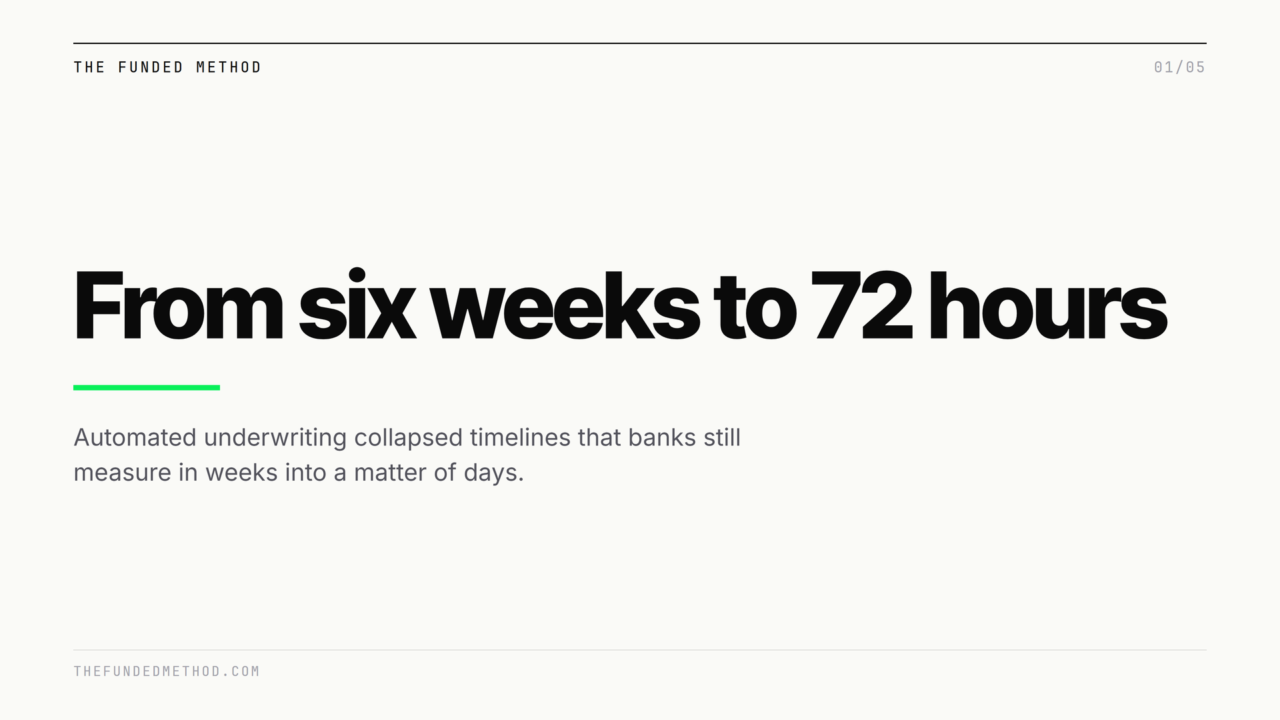
A small business owner seeking capital in 2016 measured the wait in weeks. The same owner in 2026 can measure it in hours. Across the alternative business funding market, revenue-based decisions now routinely come back within 24 to 72 hours, while the traditional routes still move at their old pace: 30 to 60 days for a bank term loan, 60 to 90 days for an SBA file, one to three weeks for a fintech term product.
That gap, from six weeks to 72 hours, is the clearest single measure of how much underwriting has changed.
Three shifts collapsed the timeline. The first is automated statement reading. Parsing months of banking activity used to take an analyst days; software now does it in minutes, extracting deposits, daily balances, and insufficient funds counts before a human ever opens the file. The second is the cash-flow model itself. Underwriting built on deposit data needs far fewer documents than underwriting built on tax returns, financial statements, and collateral appraisals, so there is simply less to collect and verify. The third is digital submission. A complete file can reach multiple underwriting desks the same morning, which turned a sequential process into a parallel one.
Speed is not free. Faster products carry higher costs, and the 72 hour decision is typically a shorter-term, more expensive instrument than the bank loan that takes two months. The trade is explicit: certainty and speed against price. What has changed is that millions of business owners now take that trade every year, because a payroll gap on Friday does not wait for a loan committee that meets on Thursdays.
The competitive consequence is already visible. Banks have spent the last several years trying to compress their own timelines, and the fintech term market exists largely because a three week decision splits the difference. But the direction of travel is one way. Once a market learns that a funding decision can arrive before the weekend, the six week version stops looking like diligence and starts looking like friction.
The Funded Method explains how modern underwriting actually reads a file, in a free interactive report at thefundedmethod.com/broker-stack.