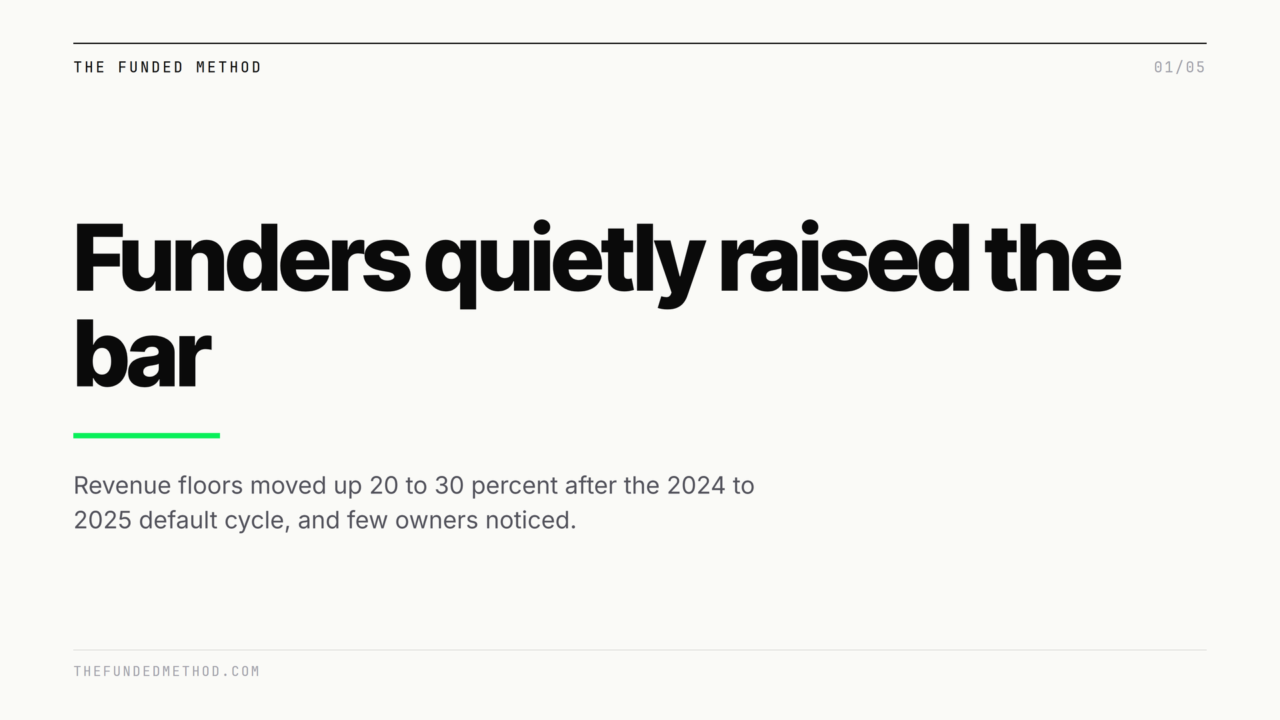
Sometime between 2024 and 2026, the standards for getting a business funded quietly moved, and almost nobody outside the industry announced it. After the default spike of 2024 to 2025, most top-tier alternative business funding underwriters raised their minimum monthly revenue floors by 20 to 30 percent. A file that funded comfortably in early 2024 can now come back declined, with the same revenue and the same credit profile.
The tightening followed a familiar cycle. Loose approvals during the post-pandemic capital rush led to rising defaults, and rising defaults led funders to redraw their criteria. But because these are private underwriting guidelines rather than published bank policy, the changes arrived without press releases. Business owners discovered them one decline at a time.
The new standards concentrate on four triggers. Negative daily balances anywhere in the last 90 days end most files before a human reads them. More than three insufficient funds incidents in a month is an immediate flag. Two or more open advances on the books is declined on sight at most desks, a hard line against the stacking behavior that drove much of the default cycle. And fewer than three months of bank statements reads as unknown risk, which underwriters now treat the same as bad risk.
Underneath all four sits a structural shift in what underwriters weight. The most recent 90 days of banking activity now carry more influence than any credit metric on the file. Underwriting has become a study of the recent past, on the theory that what a business did in the last quarter predicts the next one better than anything a credit bureau can report.
For business owners, the practical advice writes itself: protect the operating account for a full quarter before seeking capital, keep daily balances positive, and resolve open advances before applying anywhere new. For anyone studying the industry, the lesson is about how private credit markets self-correct. Banks tighten by committee and announcement. Alternative funders tighten silently, guideline by guideline, and the market only notices when the declines start.
The Funded Method tracks how funder criteria actually work in a free interactive report at thefundedmethod.com/broker-stack.